


The tech bros have succeeded at making the field of computer science embarrassing. When I began studying computer science in 2021, the usual reaction to stating the major was one of awe and admiration. I am not ashamed to admit that my ego bloomed from this reaction, and it was half of the reason that I had the willpower to get through my classes. Now, as a junior developer, I tell people that I am a software engineer and they stare at me with pity as they begin to visualize my employee ID (a rare occurrence in this economy) becoming replaced by an API key. I don’t blame them. I am also imagining it. In fact, I find it difficult not to blame myself for failing to foresee this outcome when the signs of chudification in the computer science industry have always been apparent.
When I am not feeling bad for myself for choosing to major in computer science over creative writing, I begin to view this phenomenon of chudinism as a sort of karmic retribution born out of ignorance of the field that I chose. I was never one of those kids that was interested in coding from a young age and what little knowledge I had of the subject was born from action movies and The Social Network. Half of the reason I chose the major was because I had watched the show Mr. Robot when I was 14 and was too stupid to realize that cyber security and computer science were not the same thing. The other half of the reason was money. I grew up poor and was naturally gifted in most classes and therefore was expected to become a lawyer or a doctor or an engineer. I chose the option with the least amount of time in school and the (at the time) quickest return on investment.
In college I completed three internships and worked my ass off in classes that failed to evoke any passion. I thought that the majority of the subject material was vaguely interesting and I really did enjoy the discrete math courses, but I simply did not care about optimizing systems and algorithms to fit into concrete patterns. I was in no means a great developer, but I was also not a bad one. I found that many times my professors would look at my work with confusion. During office hours I would show them my solutions and they would say, “This technically works… but why would you do it this way?” This would, of course, lead to lower scores and a few crying sessions in my professors’ offices where I would lament about how I was simply not cut out to be an engineer. The same complaints would come back from my summer internship reviews, where I was deemed a ‘unique’ problem solver who failed to go ‘above and beyond’ in any aspect that would concretely improve a company.
I quickly learned that what I believed to be a somewhat creative field that allowed for problem-solving and out of the box thinking was beginning to show itself as a field that catered to a specific type of individual. This individual cared deeply about improving systems but only in ways that would create revenue for executives in glass offices that they would never see. ‘Unique’ improvements to software were only favored if they were as profitable as they were useful. There was little to no funding given to the individuals who were doing important and groundbreaking research in fields such as computer vision and large language models if this research did not have the indirect aim of creating monetary value to someone, somewhere. I began to hope that perhaps computer science research would better suit my independent thinking than industry ever would, but after speaking with the lead of the undergrad research program I was working for one summer, it seemed he thought it necessary to warn me rather than encourage me. He directed me to the old Wordpress blogs of some of his colleagues, and I spent 4 hours reading about the disappointments of research. The fruitless attempts at funding and disinterest from the industry. The years spent on a thesis that was of little interest to those who were being paid ( a non-living wage ) to complete them.
As I approached graduation, I began to feel silly that I had ever thought that a field with such promise would lead to a job that brought fulfillment. A year into working in industry and I find it idiotic that I would have ever imagined the field to be any different. ‘Vibe coding’ is a legitimate job offered to individuals who click the ‘Enter’ key all day. Every executive in America has used the term ‘AI workflow’ incorrectly in the last week. Junior engineers are automating code reviews and then merging those pull requests into develop and their managers are standing up and applauding them for it (* sounds of Simo choking herself *). As stated before, the signs were all there. The rise of AI in the 2010s has ‘turned’ the field of computer science into an embarrassing place to live. The word ‘turned’ in quotations because if any of us were paying attention, we would have seen this coming from miles away.
so why do chuds love ai? ( ╹ -╹)?
If you go ask someone who is not in technology to describe what AI really is, they will probably say ‘I don’t know’. If you went and asked the primary investors of AI the same question in the 1960’s they would have said the same thing.
In 1956, John McCarthy coined the term ‘artificial intelligence’. At the time the term was heavily contested and held several different meanings, oftentimes jumbled with the term ‘cybernetics1’, though McCarthy chose to stray away from this term as he believed the possibilities of ‘AI’ superseded that of cybernetics. The specific use of the word ‘intelligence’ was confusing for many of McCarthy’s peers in computer science, as they assumed that the term was much too vague and over promising. Lucky for him, the term was flashy and cool enough to begin to catch on and excite the general public. Computer scientists thought the term phony while potential investors saw the word ‘intelligence’ and leaned in. Kate Crawford, a prolific researcher of AI, was a firm believer in the lack of ‘intelligence’ in the technology, and aptly stated that the concept of AI ‘is both embodied and material, made from natural resources, fuel, human labor, infrastructures, logistics, histories, and classifications’. Still, the public reached for a way to ‘create’ intelligence. A hungry man thinks of bread, or whatever they say.
The Pentagon was one of those aforementioned hungry men and lucky for them they had lots of bread. AI researchers received unlimited funding from the Pentagon, much to the dismay of other fields of computer science that were failing to obtain funding from anyone. This quote from cybernetician Heinz von Foerster summed up the view from outside of the AI bubble:
I talked with these people again and again, and I said, “Look, you misunderstand the term [Artificial Intelligence].” . . . They said, “No, no, no. We know exactly what we are funding here. It’s intelligence!” . . . At the University of Illinois, we had a big program which was not called artificial intelligence. It was partly called cybernetics, partly cognitive studies, but I was told everywhere, “Look, Heinz, as long as you are not interested in intelligence we can’t fund you.”
Chuds love a false promise of power. The definition of AI began to warp and change as a result of the funding it received, as most scientific fields do. As money poured in from U.S. defense agencies, the narrative of ‘intelligence’ became centered around how computers could ‘think’ to predict and solve the military’s problems at extremely high levels of intellect with questionable levels of confidence2. These ‘high levels of intellect’ were incredibly generalized, however, and were oftentimes unable to be properly quantified. AI’s promise to bolster the United State’s potential war efforts excited the Pentagon and confused the scientists. This would not be the first occurrence of a field of science becoming realized with imperialist funding by individuals who knew nothing of its capabilities. With continued funding, AI began to appeal more and more to nationalistic and right-wing groups whose beliefs in AI superseded their comprehension. It has never been more evident than in the year 2026 that this pattern has not stopped.
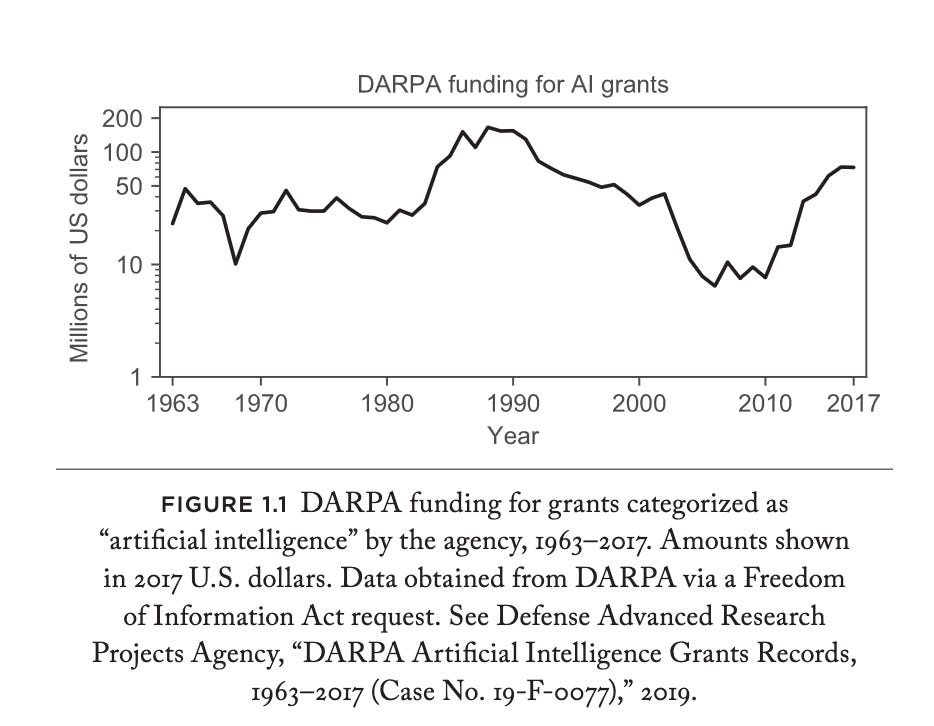
Fast forward into the 2010s, and the result of years of increased funding in AI from the US government with the hopes of increasing U.S. nationalism and aiding imperialism have become hard to escape. War has never been easier. Generating propaganda has never been easier. Funding start-ups led by 23 year old ‘developers’ who have prompted Claude for ‘ideas that can also benefit the country’ has become every right-wing politician’s favorite past-time. It is no wonder that the perception of computer science has taken such a nose dive when its biggest area of research - AI - was built on delusive marketing and shoddy promises of military expansion. Since its inception, AI has been spearheaded by false claims of power. Its early enthusiasts were happy to spin up tales of intelligence and superhuman ability to fund a field that had yet to form a solid definition of itself. We should, therefore, not be so surprised by Trump’s latest declarations that he will ‘ban the term artificial intelligence’ in favor of the equally nothing burger term “super intelligence”.
None of this is to say that taking a stance of technological optimism is inherently ignorant. We have seen time and time again the wonders that technology can create when in the right hands. ‘AI’ techniques such as machine learning and deep learning continue to transform the medical industry and improve our ability to diagnose and predict illness and disease3. Companies focused on environmentally friendly tech have discovered methods to reduce data center water usage by up to 60-70%. Innovation in technology does not have to be led and encouraged by misinformed individuals who only dream of power and monetary gain. Engineers and individuals who care about ethical technology should take the tragic story of AI’s misuse and continuous misunderstanding into account when looking into the future of technology. Rather than being motivated by greed, we should educate ourselves on the history of our field so as not to repeat the steps that brought us here.
Technology does not need to be defined by those that are unable to define its most basic concepts. In a field that is so coveted for its academic rigor and transformative nature, we have let ourselves down by devolving into a field representative of those that never understood it to begin with. We cannot be surprised that this has happened when we take a quick look into the past of technological innovation. To put it simply: the chuds wished for and monetarily backed a fast track to power at the cost of everything else. What once was a promising field with varied applications became an imperialist’s favorite do-everything tool.
I implore you to take some time out of your day to educate yourself on the technology that you are exposed to on a daily basis. I can guarantee that you will soon be more highly educated than your chud-like counterparts whose knowledge of computer science begins and ends with their own log-in information for ChatGPT.
if you don’t know where to start…
Beginner Tech News and Articles:
What is AI? - https://www.ibm.com/think/topics/artificial-intelligence
A Brief History of AI - https://ai100.stanford.edu/reports/2016-report/appendix-i-short-history-ai
Why/How does AI use energy? - https://iee.psu.edu/news/blog/why-ai-uses-so-much-energy-and-what-we-can-do-about-it
Why are Tech Workers So Sad? - https://www.noemamag.com/why-is-everyone-in-tech-so-sad/
How to Opt Out of AI Tools or Training - https://www.eff.org/pages/i-want-opt-out-ai-tools-or-training-made-big-tech
Technical Colonialism - https://datasociety.net/research-library/tech-colonialism-today/
How are Big Tech companies a threat to human rights? - https://www.amnesty.org/en/latest/news/2025/08/why-are-big-tech-companies-a-threat-to-human-rights/
Recent News in AI Reform:
(some of these links or writers do not align with my personal beliefs. I believe it is important to view them anyway to keep yourself informed)
https://www.whitehouse.gov/presidential-actions/2026/09/inaugurating-the-era-of-super-intelligence/
https://law.vanderbilt.edu/vpa-report-outlines-34-ways-to-tax-artificial-intelligence/
Simo’s Favorites Books about Technology:
(book) Artificial Whiteness - https://cup.columbia.edu/book/artificial-whiteness/9780231194914/
(book) The Tools of Empire: Technology and European Imperialism in the Nineteenth Century - Daniel R. Headrick - https://www.amazon.com/dp/0195028325?lv=shuf&channelId=500&plpRedirect=mhFallback
(book) Blockchain Chicken Farm And Other Stories of Tech in China’s Countryside - https://www.goodreads.com/en/book/show/50403472-blockchain-chicken-farm
(book) More Everything Forever - https://www.goodreads.com/book/show/212987932-more-everything-forever?ref=rae_7
(book) The Nerd Reich - https://www.goodreads.com/book/show/244382759-the-nerd-reich?ref=rae_1
Sources:
https://www.grundfos.com/media/latest-news/whitepaper--water-circularity-can-reduce-water-stress-and-boost-
https://www.anu.edu.au/news/all-news/what-is-cybernetics
https://web.mit.edu/esd.83/www/notebook/Cybernetics.PDF
https://www.ie.edu/insights/articles/why-the-term-artificial-intelligence-is-misleading/
https://yarden.github.io/pdfs/YardenKatz_ArtificialWhiteness_2020.pdf
https://www.nature.com/articles/s41746-025-01460-1
https://thehill.com/homenews/administration/6175633-trump-bans-artificial-intelligence-term/
https://news.mongabay.com/2026/08/from-radar-blobs-to-bird-species-ai-helps-transform-migration-tracking/
many still label AI as an offshoot of cybernetics or 'cybernetics 2.0' but the definition of cybernetics is a different and pertains more specifically to feedback loops between systems, and the relationships and consequences between the planet and technology. this field also boomed post ww2 and was heavily associated with military research, but it's clear that the field of ai would have benefited from a name with a clear definition as it grew in funding.
this ‘high level of intellect’ was commonly equated to that of a Ph.D level white male in elite East Coast academic spaces. do with that information what you like.
positive AI stuff: https://www.nature.com/articles/s41746-025-01460-1, https://news.mongabay.com/2026/08/from-radar-blobs-to-bird-species-ai-helps-transform-migration-tracking/, https://shinkei.systems/technology (this last one might not seem ‘positive’ if you don’t like the thought of killing fish)
Wonderful article! I would like to point out the huge problem with many chuds optimism towards Ai. I have spoken with fellow young chud colleagues that are convinced about Ai not replacing them and not leading to economical collapse. Instead chuds are convinced that Ai will lead to a wonderful universal income where they don’t have to do any work and can just run local LLMs that do their work for them. This is a common tech bro talking point. I think this view is quite unrealistic due to the historical fact why workers were given better conditions and rights in the past. When society industrialised workers were eventually given rights because the country with more content workers could produce more and better resources and in turn MORE workers by having time for children. I just don’t see how this logic can apply for a post Ai fully automated society where workers productivity and the amount of human workers means nothing for economic gain…
Good essay. I went to Yale for CS (and a double major in History) back in 2012-2016 and was on the leading edge of the new wave of CS-as-lucrative-career rather than CS-as-science: when I was looking at colleges as a high schooler, I saw that Yale had graduated 11 people with CS degrees in 2011, but by the time I graduated in 2016, CS was in the top 3 biggest majors with almost 200 of us. At the time I felt like this was a major bait-and-switch as I'd imagined having lots of 1-on-1 access to professors and peers who were in it for the pure love of algorithms (alas) rather than just startup opportunities or career ladder credentialism. But then again I probably was only even admitted in the first place because Yale made a conscious decision in 2012 to admit way more STEM/CS-oriented people and I likely would not have been in their top 11 applicants. So you take what you can get.
Regarding the history of CS and AI, I have bad news for you: it's not just AI that is this enmeshed with the military industrial complex. Aerospace Engineering might be the only other field that even comes close to being as pure a child of the MIC as Computer Science is. There was basically nothing to do with computers at all other than missile guidance and nuclear bomb simulation between 1945 and 1960, not that people back then didn't see the potential for broader applications, but the DoD was THE customer for software and it only branched out slowly from there: NASA, airlines, IBM. Cybernetics, as you referenced above, was also heavily concerned with military chains of command.
What can we do with this knowledge? Well for myself, at first, nothing. After I graduated I worked at Facebook for 3 years and saw first hand how targeted ads win "hearts and minds" waaay better than guided missiles, and both are just computer programming. But even during that time (2016-2020) I saw a change in the demographics of new engineers there away from people who just really liked computer programming and towards ambitious people who just wanted the fastest track to six figure salaries. (As an aside, how much should we lament that a place like fucking Facebook is now staffed by mercenaries rather than true believers in programming? From what I've heard, the people who work on nuclear missiles LOVE their jobs because if you don't think very hard about what happens after the missiles land, it's a fascinating and stimulating set of problems to work on, and since it doesn't pay ludicrous SV salaries, they maintain a small supply of true aerospace/nuclear "talent". Whereas if your company goes mercenary, like IBM did in the 80s and Oracle in the 90s, then real innovation becomes impossible and you can only continue to milk the inventions of yore until you fade into obscurity. This is my optimistic take on what will happen to fb/goog/etc)
I also have thoughts about the unique appeal of AI to right-wingers, but am having trouble articulating them now and this is already long.